

 John Brennan Crutchley
Dubbed the Vampire Rapist, John Brennan Crutchley was a suspected serial killer who drank the blood of one of his kidnapping victims.
 Anatoly Moskvin
In November 2011, Russian police investigating a spate of grave desecrations in cemeteries in and around Nizhny Novgorod arrested 45-year-old Anatoly Moskvin, a linguist and historian, after a terrifying discovery was made in his apartment, the mummified bodies of twenty-nine young girls who had been dressed and posed as dolls.
Beginning in 2010, Russian police began investigating a spate of desecrations of graves at cemeteries in and around the city of Nizhny Novgorod in Central Russia. The perpetrator of these particularly ghoulish crimes was known to disturb the burial sites, and steal items such as nameplates taken from headstones.
However, the most bizarre aspect of these crimes was that some graves had been emptied of the deceased occupants. In almost every case, the victim had been a recently deceased child, aged between three and thirteen, with the grave robbers removing the corpse, leaving behind the empty coffin. The only evidence left at the scene were a number of footprints left in the mud that surround the graves.
When investigators began looking into these acts of grave robbing, they uncovered evidence stretching back some ten years, involving vandalism and theft carried out at cemeteries throughout the forty regions of Nizhny Novgorod Oblast. As part of the investigation, officers consulted Anatoly Moskvin, a local historian and linguist.
A self-confessed “necropolist,” Moskvin was considered an expert on local cemeteries in Nizhny Novgorod, and police sought his assistance in helping to identify the culprit. Moskvin had previously been questioned by police in relation to a number of cases of theft and vandalism that occurred during his extensive travels throughout the Nizhny Novgorod Oblast.
Moskvin had been commissioned to summarize and list the dead in more than 700 cemeteries in forty regions of Nizhny Novgorod Oblast, a task that involved him inspecting on foot the 752 cemeteries in the region. The research would take him over two years to complete, and involved much travel across the region.
During these travels, which took place between 2005 to 2007, Moskvin claimed he would often walk up to 30km (20 miles) a day and to have drank from puddles, spent nights in haystacks and at abandoned farms, and even slept in the cemeteries themselves. During one instance, he reportedly spent a night in a coffin being prepared for a funeral.
On several occasions, he was questioned by police concerning the desecrations that had been reported in the area where he was conducting his research, but was never arrested because of his Government credentials and the nature of his work, that allowed him unrestricted access to cemeteries and grave sites.
It was not until the following year, in November 2011, that Anatoly Moskvin was taken in for questioning in relation to the spate desecrations. He was ultimately charged with the crime of grave robbing, however the circumstances of his arrest are unclear, but one rumor emerged that he had been caught with a bag of bones, taken from a recently disturbed grave.
The case caused revulsion along the Russian populace and international observers, who saw the ghoulish crimes of Anatoly Moskvin . Indeed, the crimes were similar in nature to the case of Carl von Cosel, also known as Carl Tanzler, a German-born American radiology technologist who became infatuated with a young woman and subsequently lived with her corpse, and attempted to preserve the body from decomposition.
When Russian investigators from the Centre for Combating Extremism entered the Moskvin family home, they made a horrifying discovery. Twenty-six bodies, initially reported by the press as twenty-nine, were found throughout the flat and garage. These bodies were found in a state of mummification and dressed as what Moskvin described as “dolls”.
Video footage of the police raid on Moskvin’s home was released by police, showing the bodies of young children seated on shelves and sofas in small rooms, which are full of books, papers and other clutter. There were also maps of cemeteries in the region of Nizhny Novgorod, and instructions for making dolls.
Detectives also found a collection of photographs and videos depicting open graves and disinterred bodies, evidence that could be conclusively connected to any of the bodies found in the apartment, as well as Moskvin’s shoes that matched footprints found in the some of the cemeteries.

The victims bodies, whose ages ranged from three to thirteen, primarily came from cemeteries in the Nizhny Novgorod region, though some may have come from as far away as Moscow. During his interrogation, Anatoly Moskvin revealed to police his method of procuring the corpses and process for preserving their remains.
Moskvin calimed that he felt enormous sympathy for the dead children and thought that they could perhaps be brought back to life through either scientific means or black magic. As an expert on Celtic culture, Moskvin read about how the ancient Druids slept on graves in order to communicate with spirits of their dead.
He also studied the culture of the ancient Yakuts, a Turkic ethnic group of people native to North Siberia, and learned they had a similar practice for communicating with the dead. As part of the Yakut belief system, this communication with the dead generally occurred as a part of shamanic practices and rituals.
Moskvin began searching for obituaries of recently deceased children, and upon finding an obituary that “spoke” to him, he would sleep on the grave in order to communicate with the deceased child and determine if the spirit wished to be brought back to life. When police asked how long he had been doing this ghoulish practice, his answer shocked detectives.
Moskvin claimed he had been communicating with the dead and disturbing graves for roughly the last twenty years, but insisted that when he began, he never disturbed a child’s grave without the permission of the deceased occupant within. As he grew older it made it more difficult for Moskvin to sleep on the graves.
As a result, he began taking the corpses home with him, so it would be more comfortable for him to sleep near them. He explained how he hoped the spirits would be better willing to communicate within a safe, welcoming home and that they might be easier to hear when they were no longer underground.
But he soon encountered another problem. The bodies would soon decay and he feared the putrefying smell that accompanied the decomposition might alert neighbors to his grave robbing. Moskvin set about mummifying the bodies himself, in a effort to preserve the remains, and researched mummification theories and techniques.
Using a combination of salt and baking soda, Moskvin dried the corpses, and then secured them in dry places in and around cemeteries. Once they had fully dried, he carried them to his home and there used various methods to create “dolls,” in order to give the children functional bodies they could use when they were eventually brought back to life.

Moskvin claimed the physical remains, that had begun to decay, were too ugly for the children to feel comfortable or happy. However, he was unable to prevent the bodies from withering and shrinking as they dried, and he was forced to wrap the limbs in strips of cloth and stuff rags inside the body cavity to create padding to prevent them from collapsing.
For the “dolls” faces, he made wax masks decorated with nail polish, and dressed the bodies in brightly colored children’s clothing and wigs. This made the bodies appear to be large homemade dolls, which aroused little suspicion from Moskvin’s parents who shared the apartment with him, and the couple had one of the mummified bodies in their bedroom, unaware it was the corpse of a child.
Moskvin spent a considerable amount of time with the “dolls” he had made, and posed them around his home. He watched children’s fairy-tale films and read books and sang songs to them, and always celebrated their birthdays with tea parties. Moskvin revealed that he was motivated by his own desire to have children, and that he had always wanted a daughter.
He told police that although he was aware that he had committing very serious crimes by taking the children’s remains, he felt the dead were “calling out” to be rescued and believed that rescuing these children and taking their remains home was more important than abiding by the law. His fascination for the dead had first been awoken when he was himself just a child.
Born in the Russian city of Gorky, during the time of the Soviet Union on September 1, 1966, Anatoly Yuryevich Moskvin had a long held fascination for the dead. As a schoolboy, he would wander through cemeteries with friends, particularly the Krasnaya Etna Cemetery in the city’s Leninsky district.
After his arrest, Moskvin told a disturbing story about an incident that happened during his childhood, and to which he attributed his morbid interest in the dead. As a child he witnessed a funeral procession for an eleven-year-old girl. Moskvin alleged those attending forced him to kiss the dead girl.
He told investigators that he was made to kiss the girl’s face, claiming “an adult pushed my face down to the waxy forehead of the girl in an embroidered cap, and there was nothing I could do but kiss her as ordered.” This incident had a profound effect on the young boy, and his fascination for the dead only increased.

After his graduation from the philological faculty of Moscow State University, where he studied Celtic history and folklore, as well as languages and linguistics, Antoly Moskvin became a well known figure in academic circles. Privately, he developed a deep rooted interest in cemeteries, burial rituals and funeral rites.
Coupled with this ghoulish fascination for the recently deceased, Moskvin became enamoured with death and the occult. In his personal library he kept over 60,000 books and documents, and was described by his fellow academics as a somewhat eccentric genius. He led a secluded life, refrained from drink and drugs, never married or even dated, and lived with his elderly parents.
A former lecturer in Celtic studies at Nizhny Novgorod Linguistic University, Moskvin had previously worked at the Institute of Foreign Languages. As a noted philologist and linguist, the polyglot Moskvin spoke thirteen languages fluently and had written several books, papers, and translations, all of which became well known in academic circles.
He regularly contributed to local newspapers and other publications, sharing his knowledge of history and linguistics. However, his true passion lay in the dead and their resting places. A self-styled “necropolist,” Moskvin was considered an expert on local cemeteries in Nizhny Novgorod Oblast.
In 2005, he was commission by Oleg Riabov, a fellow academic and publisher, to summarize and list the dead in more than 700 cemeteries in forty regions of Nizhny Novgorod Oblast. This work took over two years to complete, with Moskvin visiting on the foot to inspect the 752 cemeteries across the region.
It was during his time travelling and visiting cemeteries that Moskvin was questioned by police concerning the vandalism and theft that was taking place in some areas. Despite this, Moskvin was never considered a suspect in the crimes. Once his work was complete, it was described as “unique” and “priceless” by Alexei Yesin, the editor of ‘Necrologies’, a weekly paper to which Moskvin was a regular contributor.

In 2006, shortly after his commission by Riabov, Moskvin also worked as a freelance correspondent for the newspaper Nizhny Novgorod Worker, publishing articles twice a month until 2010. His father also sometimes contributed articles for the same paper. In a 2007 interview with the newspaper Nizhegorodsky Rabochy, Moskvin revealed how he had begun wandering through cemeteries when still a schoolboy.
During 2008, he wrote a comprehensive series of articles on the history of Nizhny Novgorod cemeteries that appeared in the paper. After Moskvin’s arrest, Yesin stated that he was confident there had been a mistake and that Moskvin would be exonerated. However, when the full horror of his crimes were revealed, Yesin spoke with the Associated Press news agency about his former colleague.
He described Moskvin as having had “certain quirks” but said he had given no indication that he was up to anything so strange. “I saw no signs of that while working with him,” Mr Yesin said. According to those few people who knew him, no-one could have suspected Anatoly Moskvin of the terrible secrets he kept in his parents home.
Although the remains of twenty-six victims were discovered, Moskvin was suspected of desecrating as many as 150 graves. During the search of his home, police found numerous grave accoutrements such as metal nameplates that had been removed from headstones. Some Russian media outlets reported that Muslim graves were singled out in the robberies.
Moskvin actively cooperated with the investigation, and claimed he had made the “dolls” over the course of a ten year period. His parents, according to Moskvin, had no knowledge of his crimes, or even that one of the dolls in their bedroom was the remains of a child, and were away for large portions of the year, and thus unaware of what had transpired.
Moskvin was charged under Article 244 of the Criminal Code, namely for the desecration of graves and dead bodies, a charge that carried a penalty of up to five years in prison. Anatoly Moskvin was originally accused of committing a hate crime, that of defacing the graves of Muslims, but this charge was later dropped.

He underwent a psychiatric evaluation, which determined Moskvin had a form of paranoid schizophrenia. At a May 2012 hearing, at the Leninsky District Court of Nizhny Novgorod, Moskvin was deemed unfit to stand trial, a decision that ultimately released him from criminal liability.
He was instead sentenced to court-ordered psychiatric evaluation, which involved what was termed “coercive medical measures.” Satisfied with the decision, the prosecution did not appeal the verdict. Held in a psychiatric clinic, Moskvin was placed under regular review concerning his treatment and possible rehabilitation.
A hearing in February 2013 approved an extension of his court mandated treatment, which was again extended in April 2014. In 2014 a spokesman for the hospital stated, “After three years of monitoring him in a psychiatric clinic, it is absolutely clear that Moskvin is not mentally fit for trial.”
“He will therefore be kept for psychiatric treatment at the clinic.” This meant his treatment was extended for a third time in July 2015. By September 2018, Moskvin’s doctors stated their belief that he was no longer a danger to the public, and petitioned the court to release him for outpatient care from home.
However, in February 2019, a detailed psychiatric evaluation found that Moskvin had not responded adequately to his treatment and would, if released, continue to commit crimes of a similar nature. As a result, the hospital withdrew their petition for his release. Anatoly Moskvin had since remained in a psychiatric hospital.
During his interrogation, Moskvin told investigators that he often regretted that he never had children and at one point attempted to adopt a young girl against the wishes of his parents, but his application was rejected because of his low income. According to Moskvin, there was never any sexual attraction to the children he made into dolls.
He stated that he simply wanted to care for them, speak with them, and eventually… bring them back to life. Vladimir Stravinskas, the head of the Investigative Committee of Russia for the Nizhny Novgorod region, called the case of Anatoly Moskvin, “exceptional and unparalleled in modern forensics.”
 John Brennan Crutchley
 Dubbed the Vampire Rapist, John Brennan Crutchley was a suspected serial killer who drank the blood of one of his kidnapping victims.
 Red Inn Murders
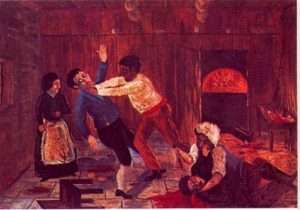
 The Red Inn Murders were occurred in France during the 19th century, where the proprietors of an inn killed and cannibalised their clientele.
 George “G” Williams
 During the 1990’s and early 2000’s, George “G” Williams carried out a murderous vendetta against Suge Knight and his Death Row Records.
 Nancy Guthrie Kidnapping
 The Nancy Guthrie Kidnapping occurred on February 1, 2026, when the 84-year-old mother of US News anchor Savannah Guthrie vanished.
 Atlas Vampire Case
 The unsolved murder of a Swedish prostitute has become known as the Atlas Vampire case, because the killer drank the victims blood.
 Ian Watkins
 As the lead singer of Welsh rock band the Lostprophets, Ian Watkins had legions of fans, but few could know he was a prolific child abuser.
Copyright © 2025 The True Crime Database. All Rights Reserved.