John Brennan Crutchley
Dubbed the Vampire Rapist, John Brennan Crutchley was a suspected serial killer who drank the blood of one of his kidnapping victims.
Phrenology, a pseudoscience that gained popularity in the 19th century, sought to link the shape and contours of the skull to various personality traits and mental faculties.
Despite its dubious scientific basis, phrenology found its way into many aspects of society, including crime investigations and law enforcement practices.
Developed by German physician Franz Joseph Gall in the late 18th century, phrenology proposed that the brain’s structure influenced an individual’s character and intelligence.
The idea was that specific areas of the brain were responsible for different faculties, and by examining the bumps and depressions on the skull’s surface, one could infer a person’s mental attributes.
During the 19th century, phrenology gained popularity as a tool for understanding and classifying individuals. Its allure extended to law enforcement, where proponents believed that analyzing criminals’ skulls could reveal predispositions to criminal behavior.
Police departments and prisons, eager to adopt any method promising insights into criminality, began incorporating phrenological principles into their practices.
Phrenologists argued that certain skull features, such as the shape of the forehead or the prominence of certain areas, could indicate criminal tendencies or moral deficiencies.
This belief led to the establishment of phrenological departments within police forces and the collection of extensive skull measurements from criminals, creating the infamous “criminal skulls” archives.
One prominent example of phrenology’s influence on criminal investigations is the work of Cesare Lombroso, an Italian criminologist of the late 19th and early 20th centuries.
Lombroso, influenced by phrenological ideas, proposed that certain physical characteristics, such as a low forehead, strong jaw, or asymmetrical face, were indicative of a “born criminal.”
He believed that criminals could be identified by their physical appearance and sought to apply this theory to criminal profiling.
Despite the widespread use of phrenology in crime investigations, it faced significant criticism from the scientific community.
Many scholars and scientists rejected the notion that the external shape of the skull could accurately reflect an individual’s mental or moral attributes.
Critics argued that phrenology lacked empirical evidence, relied on subjective interpretations, and was susceptible to bias.
As the 19th century progressed, advancements in neurology and the development of more rigorous scientific methodologies discredited phrenology.
The field lost its appeal among mainstream scientists, and its influence waned in the early 20th century.
Today, phrenology is viewed as a pseudoscience, and its historical application in criminal investigations is often seen as an example of the pitfalls of relying on unfounded theories in law enforcement.
The notion that physical characteristics could predict criminal behavior has long been debunked, and modern criminal profiling relies on evidence-based practices and behavioral analysis rather than pseudoscientific methods.
The legacy of phrenology serves as a cautionary tale about the dangers of incorporating unproven scientific ideas into the criminal justice system.
While the historical use of phrenology in crime investigations may be seen as a product of its time, it highlights the importance of subjecting forensic methodologies to rigorous scientific scrutiny to ensure their reliability and validity.
The rejection of phrenology ultimately contributed to the advancement of more sound and evidence-based practices in criminal investigations, marking a critical evolution in the history of forensic science.

Dubbed the Vampire Rapist, John Brennan Crutchley was a suspected serial killer who drank the blood of one of his kidnapping victims.

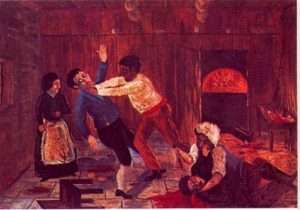
The Red Inn Murders were occurred in France during the 19th century, where the proprietors of an inn killed and cannibalised their clientele.

During the 1990’s and early 2000’s, George “G” Williams carried out a murderous vendetta against Suge Knight and his Death Row Records.

The Nancy Guthrie Kidnapping occurred on February 1, 2026, when the 84-year-old mother of US News anchor Savannah Guthrie vanished.

The unsolved murder of a Swedish prostitute has become known as the Atlas Vampire case, because the killer drank the victims blood.

As the lead singer of Welsh rock band the Lostprophets, Ian Watkins had legions of fans, but few could know he was a prolific child abuser.
Copyright © 2025 The True Crime Database. All Rights Reserved.