#0186

Thuggee Cult

The Indian Death Cult

Thuggee Cult

"yellow scarf"

Cult of Death: The Thuggee

The Thuggee cult, a secret and criminal organization that operated in India for centuries, became infamous for its systemic and violent activities.

The cult, which flourished during the 14th to the 19th centuries, was involved in ritualistic robbery and murder, creating an atmosphere of fear and dread in the regions where they operated.

The suppression of the Thuggee cult by the British East India Company in the 19th century marked the end of a dark chapter in Indian history.

The term “Thuggee” is derived from the Hindi word “thag,” meaning deceiver or thief. The Thuggees were a highly organized and secretive group, composed primarily of criminals who disguised themselves as travelers or merchants to gain the trust of unsuspecting victims.

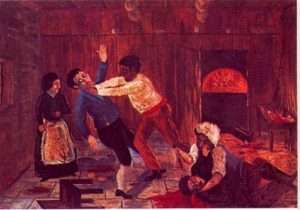
Once the Thuggees had infiltrated a group, they would strike, often during the cover of night, using a distinctive method known as “phansigari” – the act of strangulation using a rumal, a handkerchief-like cloth.

The cult’s crimes were not only brutal but also deeply ritualistic. Thuggees believed that the act of strangulation was a sacred offering to the goddess Kali, whom they considered their patron deity.

These ritualistic aspects added a layer of mystique to their criminal endeavors, creating an aura of terror among the population.

The Thuggees primarily targeted travelers on major trade routes, taking advantage of the chaotic and diverse nature of India’s historical road network.

The vastness of the subcontinent and the lack of effective law enforcement allowed the Thuggees to operate with relative impunity for centuries.

It wasn’t until the British East India Company began to expand its control over India in the 19th century that concerted efforts were made to suppress the Thuggee cult.

The East India Company, recognizing the threat posed by the Thuggees to both British and Indian interests, initiated a systematic campaign to eradicate the cult and its criminal activities.

The suppression of the Thuggee cult gained momentum under the leadership of British officer William Henry Sleeman.

Appointed as the Superintendent of the Thuggee and Dacoity Department, Sleeman spearheaded efforts to identify, capture, and prosecute Thuggees and their leaders.

His meticulous record-keeping and intelligence-gathering methods played a crucial role in the success of the campaign.

The British authorities faced numerous challenges in combating the Thuggees. The cult operated in small, decentralized groups, making it difficult to track and apprehend its members.

Additionally, the Thuggees often enjoyed local support and protection, complicating efforts to root out the criminal network.

Sleeman’s campaign, however, achieved notable success. Through a combination of intelligence operations, surveillance, and the use of informants, the British authorities were able to dismantle the Thuggee cult systematically.

Thousands of Thuggees were arrested, and many were executed or imprisoned. The suppression of the Thuggee cult had a profound impact on Indian society.

While the eradication of the Thuggees contributed to improved safety on major trade routes, it also led to the loss of a certain mystique associated with the cult.

The British campaign against the Thuggees, though effective in curbing their criminal activities, also left a complex legacy, with some viewing it as an example of colonial intervention and control.

The Thuggee cult, once a pervasive and menacing force in India, was effectively dismantled by the British East India Company in the 19th century.

The systematic campaign led by William Henry Sleeman marked the end of centuries of ritualistic robbery and murder, bringing a sense of relief to the people of India.

The suppression of the Thuggee cult remains a significant chapter in the history of British colonial rule in India, reflecting both the challenges of eradicating organized crime and the complexities of cultural interactions during this period.

Written by Nucleus

Share with your friends :

Search for Ted Bundy Los Zetas Nazi Doctors

Related Case files

John Brennan Crutchley

Dubbed the Vampire Rapist, John Brennan Crutchley was a suspected serial killer who drank the blood of one of his kidnapping victims.


This content is for Gold, Gold Annual (Discounted), Life Time Membership, and Gold Annual (Free Trial) members only.

Get Free Access to the biggest Criminal Database on the web.
Login Free Trial

Read More »

Red Inn Murders

The Red Inn Murders were occurred in France during the 19th century, where the proprietors of an inn killed and cannibalised their clientele.


This content is for Gold, Gold Annual (Discounted), Life Time Membership, and Gold Annual (Free Trial) members only.

Get Free Access to the biggest Criminal Database on the web.
Login Free Trial

Read More »

Featured Case files

Atlas Vampire Case

The unsolved murder of a Swedish prostitute has become known as the Atlas Vampire case, because the killer drank the victims blood.

Read More »

Ian Watkins

As the lead singer of Welsh rock band the Lostprophets, Ian Watkins had legions of fans, but few could know he was a prolific child abuser.

Read More »

Search for Ted Bundy Los Zetas Nazi Doctors

Search True Crime

True Crime Categories

Become A Member

Join our 3 day free trial for the following benefits

  • 3 Day Free Trial
  • Remove Ads
  • Official Member of The True Crime Database
  • Immediate Access to ALL New Case Files
  • Access to the FULL back catalogue of Case Files